Artificial Intelligence and Business Security
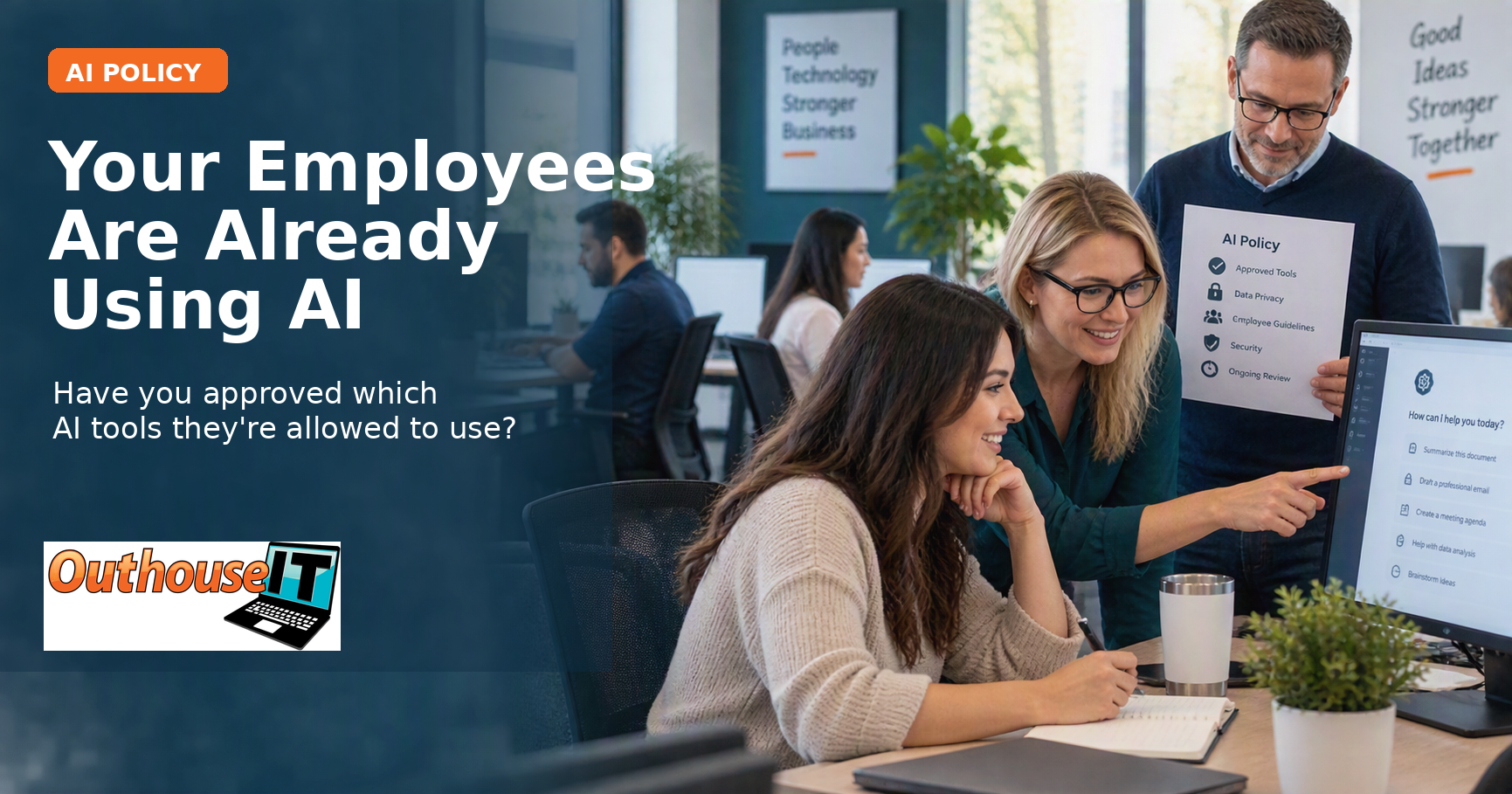
Your employees are probably already using AI.
Not next year. Not after the next software refresh. Not after management approves a project. Right now.
Across small and midsize businesses, employees are using AI to draft emails, summarize meetings, generate marketing content, write procedures, create spreadsheets, perform research, and help solve day-to-day business problems.
The question is no longer whether your business will use AI.
The question is whether your employees are using AI within a framework designed to protect your business.
They have a governance problem. Employees are adopting new tools faster than policies are being created.
The AI Adoption Problem Nobody Planned For
A few years ago, businesses could reasonably assume employees would only use approved software installed by IT.
AI changed that.
Today, employees can create an account, open a browser, and begin using an AI platform in minutes. No software installation is required. No purchasing approval is required. In many cases, managers never know it happened.
Most employees are not trying to bypass company processes. They're simply looking for ways to work faster and accomplish more.
That creates a difficult situation for leadership. Productivity increases can be real, but so can the risks associated with unmanaged AI adoption.
The Risk Isn't AI
Many business owners assume the safest approach is to ban AI completely.
In reality, outright bans often fail because employees continue using AI without guidance, visibility, or accountability.
The larger risk is unmanaged AI.
Without clear direction, employees may enter information into AI systems without understanding how that information is stored, processed, or retained.
Examples include:
- Client information
- Financial information
- Internal procedures
- Contracts and agreements
- Employee information
- Operational documentation
- Strategic plans and business objectives
When employees receive no guidance, they make their own decisions about which tools to trust and what information is appropriate to share.
The biggest AI risk is not that employees use it. The biggest risk is that employees use it without direction.
Not All AI Platforms Handle Data the Same Way
One of the most common misconceptions is that all AI platforms operate the same way.
They don't.
Different providers offer different privacy controls, retention settings, administrative controls, business protections, and compliance capabilities.
Some platforms are designed primarily for individual users. Others include enterprise controls intended for business environments.
Without a defined strategy, employees often choose whichever tool is most popular, easiest to access, or recommended by a colleague.
That approach may improve productivity, but it does not provide leadership with visibility into how company information is being used.
What Every Small Business AI Policy Should Include
An effective AI policy does not need to be lengthy or complicated.
In many cases, one clear page is enough to establish expectations and reduce uncertainty.
Include
|
Clearly Prohibit
|
AI Policies Don't Need to Slow Innovation
Some leaders worry that introducing policies will discourage experimentation and reduce productivity gains.
In practice, the opposite is often true.
When employees know which tools are approved and how to use them safely, adoption becomes more consistent, more productive, and easier to support.
Clear expectations reduce confusion.
Clear expectations improve accountability.
Most importantly, clear expectations help protect the business while still allowing employees to benefit from new technology.
The Businesses That Benefit Most From AI Won't Be the Ones That Ban It
AI is becoming a normal part of modern business operations.
Whether leadership has formally adopted AI or not, employees are already exploring ways to use it.
The organizations that gain the most value will not be the ones that ignore AI, and they probably won't be the ones that try to prohibit it entirely.
They will be the organizations that choose approved tools, establish clear expectations, protect sensitive information, and provide guidance before problems occur.
Need Help Building an AI Policy?
Not sure which AI tools your employees are already using or how to create a practical AI policy? Outhouse IT can help you evaluate available options, identify risks, and create clear guidelines that support both productivity and security.